The Ranji Trophy has been India’s premier domestic cricket competition since 1934.
Named after Ranjitsinhji, the first Indian cricketer to play at the highest level, this tournament has shaped generations of players.
Every Indian star who’s worn the national jersey learned their craft here.
The 2024–25 season saw Vidarbha lift the trophy after their final against Kerala ended in a draw.
Under Ranji Trophy rules, the first-innings lead decided it.
That gave Vidarbha their third title in recent years and proved they’re among the strongest teams in domestic cricket right now.
The 2025–26 season is underway with teams battling for glory and players fighting for national recognition.
Ranji Trophy Winners List From 1934 To 2026
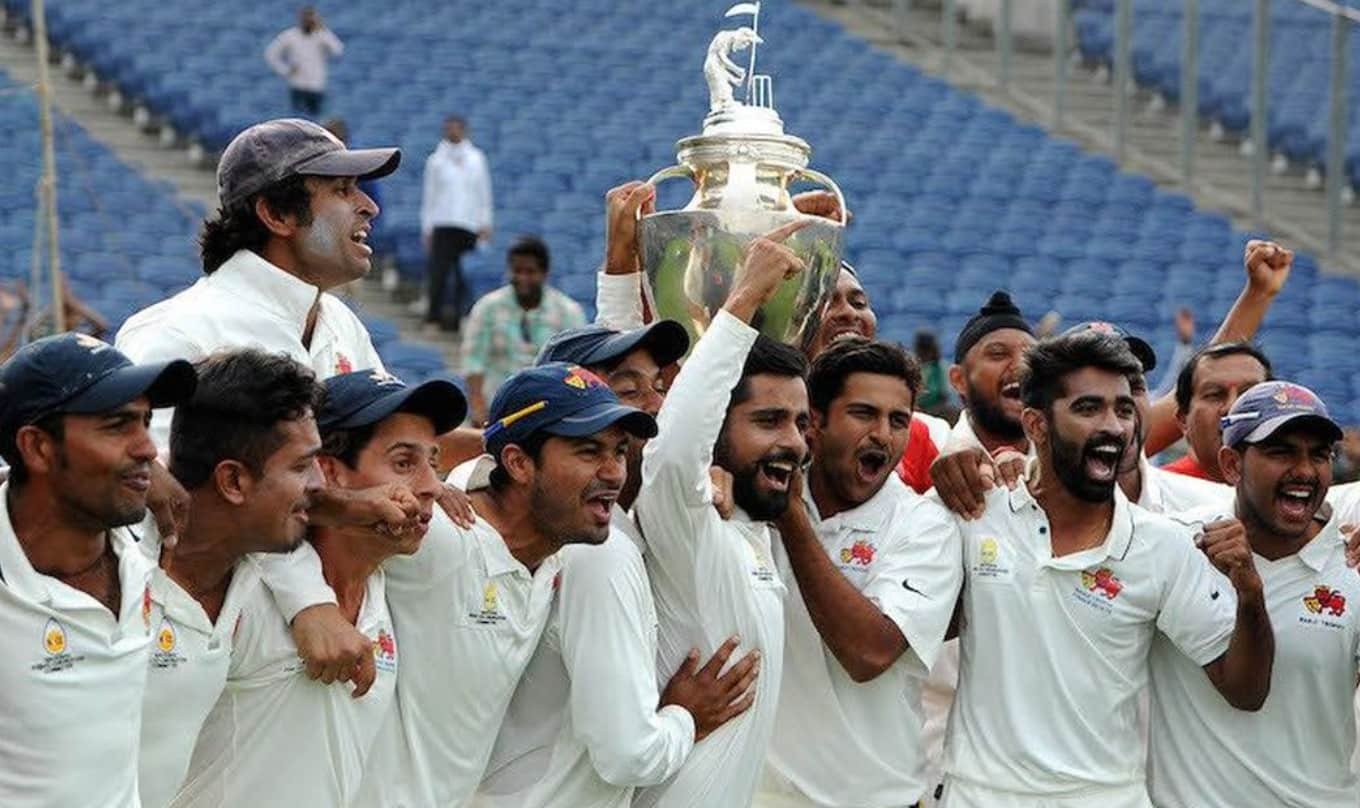
Complete Championship Records From 1934 To 2026
The Ranji Trophy winners list spans nine decades of Indian cricket history. It shows which teams built dynasties, which ones had their moments, and which runners-up came close but couldn’t finish.
Here’s every champion and runner-up since the tournament began:
| Season | Champion | Runner-Up |
|---|---|---|
| 1934-35 | Bombay | Northern India |
| 1935-36 | Bombay | Madras |
| 1936-37 | Nawanagar | Bengal |
| 1937-38 | Hyderabad | Nawanagar |
| 1938-39 | Bengal | Southern Punjab |
| 1939-40 | Maharashtra | United Provinces |
| 1940-41 | Maharashtra | Madras |
| 1941-42 | Bombay | Mysore |
| 1942-43 | Baroda | Hyderabad |
| 1943-44 | Western India | Bengal |
| 1944-45 | Bombay | Holkar |
| 1945-46 | Holkar | Baroda |
| 1946-47 | Baroda | Holkar |
| 1947-48 | Holkar | Bombay |
| 1948-49 | Bombay | Baroda |
| 1949-50 | Baroda | Holkar |
| 1950-51 | Holkar | Gujarat |
| 1951-52 | Bombay | Holkar |
| 1952-53 | Holkar | Bengal |
| 1953-54 | Bombay | Holkar |
| 1954-55 | Madras | Holkar |
| 1955-56 | Bombay | Bengal |
| 1956-57 | Bombay | Services |
| 1957-58 | Baroda | Services |
| 1958-59 | Bombay | Bengal |
| 1959-60 | Bombay | Mysore |
| 1960-61 | Bombay | Rajasthan |
| 1961-62 | Bombay | Rajasthan |
| 1962-63 | Bombay | Rajasthan |
| 1963-64 | Bombay | Rajasthan |
| 1964-65 | Bombay | Hyderabad |
| 1965-66 | Bombay | Rajasthan |
| 1966-67 | Bombay | Rajasthan |
| 1967-68 | Bombay | Madras |
| 1968-69 | Bombay | Bengal |
| 1969-70 | Bombay | Rajasthan |
| 1970-71 | Bombay | Maharashtra |
| 1971-72 | Bombay | Bengal |
| 1972-73 | Bombay | Tamil Nadu |
| 1973-74 | Karnataka | Rajasthan |
| 1974-75 | Bombay | Karnataka |
| 1975-76 | Bombay | Bihar |
| 1976-77 | Bombay | Delhi |
| 1977-78 | Karnataka | Uttar Pradesh |
| 1978-79 | Delhi | Karnataka |
| 1979-80 | Delhi | Bombay |
| 1980-81 | Bombay | Delhi |
| 1981-82 | Delhi | Karnataka |
| 1982-83 | Karnataka | Bombay |
| 1983-84 | Bombay | Delhi |
| 1984-85 | Bombay | Delhi |
| 1985-86 | Delhi | Haryana |
| 1986-87 | Hyderabad | Delhi |
| 1987-88 | Tamil Nadu | Railways |
| 1988-89 | Delhi | Bengal |
| 1989-90 | Bengal | Delhi |
| 1990-91 | Haryana | Bombay |
| 1991-92 | Delhi | Tamil Nadu |
| 1992-93 | Punjab | Maharashtra |
| 1993-94 | Bombay | Bengal |
| 1994-95 | Bombay | Punjab |
| 1995-96 | Karnataka | Tamil Nadu |
| 1996-97 | Mumbai | Delhi |
| 1997-98 | Karnataka | Uttar Pradesh |
| 1998-99 | Karnataka | Madhya Pradesh |
| 1999-00 | Mumbai | Hyderabad |
| 2000-01 | Baroda | Railways |
| 2001-02 | Railways | Baroda |
| 2002-03 | Mumbai | Tamil Nadu |
| 2003-04 | Mumbai | Tamil Nadu |
| 2004-05 | Railways | Punjab |
| 2005-06 | Uttar Pradesh | Bengal |
| 2006-07 | Mumbai | Bengal |
| 2007-08 | Delhi | Uttar Pradesh |
| 2008-09 | Mumbai | Uttar Pradesh |
| 2009-10 | Mumbai | Karnataka |
| 2010-11 | Rajasthan | Baroda |
| 2011-12 | Rajasthan | Tamil Nadu |
| 2012-13 | Mumbai | Saurashtra |
| 2013-14 | Karnataka | Maharashtra |
| 2014-15 | Karnataka | Tamil Nadu |
| 2015-16 | Mumbai | Saurashtra |
| 2016-17 | Gujarat | Mumbai |
| 2017-18 | Vidarbha | Delhi |
| 2018-19 | Vidarbha | Saurashtra |
| 2019-20 | Saurashtra | Bengal |
| 2020-21 | Not Held | Covid-19 |
| 2021-22 | Madhya Pradesh | Mumbai |
| 2022-23 | Saurashtra | Bengal |
| 2023-24 | Mumbai | Vidarbha |
| 2024–25 | Vidarbha | Kerala |
| 2025-26 | Ongoing | Ongoing |
The Tournament’s Journey Since 1934
Bombay won the inaugural title in 1934–35, beating Northern India in the final.
The competition was set up to honor Ranjitsinhji, who’d made history representing England decades earlier despite being Indian.
The tournament’s purpose was clear from day one – develop Indian cricketers for the future.
The early structure relied on zones. Teams competed within their regions first.
North, West, East, and South zones each crowned winners who then faced off in inter-zonal matches.
The Central zone joined the setup in 1952–53, spreading the tournament across more of India.
That zonal format lasted until 2002–03 when everything got restructured. The zones disappeared, and a new two-tier system arrived.
Elite and Plate divisions took over, with 38 teams now competing.
Elite teams face tougher competition while Plate teams get chances to develop. The system’s still running this way today.
Mumbai’s Unbeatable Championship Tally
Mumbai sits on 42 Ranji Trophy titles. That number is absolutely massive when you consider Karnataka is in second place with just 8 wins. Delhi has 7.
The gap between Mumbai and everyone else is wider than most teams’ entire trophy collections.
Between 1958–59 and 1972–73, Mumbai won 15 consecutive championships. Fifteen straight years without losing once.
During that run, Rajasthan made six finals and lost every single one to Mumbai.
Imagine being good enough to reach six finals but facing a team so dominant you can’t win any of them. That’s mental torture.
Mumbai’s success wasn’t luck or a few good players. They had superior infrastructure, better coaching systems, and a culture that bred winners.
Young players grew up watching championship teams and learned what excellence looked like.
That knowledge was passed down through generations, creating a self-sustaining cycle of success.
Emerging Champions In Modern Times
The past decade brought new names to the championship podium.
Vidarbha, Saurashtra, and Madhya Pradesh won titles despite having nowhere near the history of traditional powers.
Competition has become more balanced, making every season less predictable.
Vidarbha’s three titles (2017–18, 2018–19, 2024–25) show they’ve built something real. They didn’t fluke one championship and fade away.
They created a team culture that handles pressure, performs in knockouts, and delivers when championships are on the line.
Saurashtra claimed titles in 2019–20 and 2022–23 through sheer grit. They don’t have the flashiest players, but they grind opponents down over four days.
That approach works brilliantly in first-class cricket where patience and discipline beat talent alone.
Madhya Pradesh’s 2021–22 win over Mumbai sent shockwaves through domestic cricket.
A team with zero championship pedigree taking down the most successful franchise in tournament history?
That result proved that anyone can win with the right preparation and execution.
Tactical View: Playing For First-Innings Advantage
Finals create special pressure because draws don’t mean replays.
The first-innings lead rule means whoever’s ahead after both teams bat once walks away with the trophy if time runs out.
That knowledge shapes captains’ decisions from the coin toss onward.
Days one and two become absolutely critical. Teams batting first need to post big totals. Making 300 isn’t enough anymore.
You want 420-plus to build a cushion. If you’re bowling first, you need early breakthroughs to restrict the opposition under 350.
The margin established in the first innings often decides everything.
The psychological impact is massive. Picture batting in the second innings while trailing by 160 runs. Every wicket feels heavier.
Bowlers know mistakes cost double. Even average bowling becomes tough to face when scoreboard pressure’s crushing you.
That mental weight separates teams that win finals from those who don’t.
Smart captains manipulate this. When batting with a 200-run first-innings lead, they attack more freely in the second innings.
Why? The buffer protects them. Even a collapse for 180 leaves the opposition chasing 380-plus in the fourth innings on a wearing pitch.
That freedom completely changes batting approaches.
Today’s Competition Format
League matches run in groups. Elite division teams play within pools designed for competitive balance and manageable travel.
Top performers from each pool advance to the knockout stages. This setup ensures quality cricket while keeping costs reasonable.
Plate division teams compete separately with fewer matches. They fight for promotion opportunities and development chances.
This pathway lets smaller cricket associations build programs without getting destroyed by established powers every week.
Knockouts follow traditional structure. Quarter-finals, semi-finals, then a championship final. All matches last four full days.
No shortened formats or modifications. Teams win by playing proper first-class cricket the way it’s meant to be played.
The System That Builds International Cricketers
Every Indian cricket legend learned their trade in the Ranji Trophy.
Gavaskar’s patience, Tendulkar’s aggression, Dravid’s technique, Kohli’s intensity – they all got refined here first.
The tournament’s record for producing international talent is unmatched anywhere.
Different conditions across India force complete skill development.
Batting on a turner in Chennai teaches different lessons than facing pace in Mohali or swing in Delhi.
Players who succeed everywhere prove they can handle any challenge. That versatility becomes crucial when representing India worldwide.
The pathway remains functional today. Sarfaraz Khan dominated Ranji Trophy cricket for years before earning his India call-up.
Yashasvi Jaiswal crushed this level and moved up. As long as standards stay high, the tournament will keep producing international cricketers.
Championship Moments That Made History
Mumbai’s twin tail-end centuries in 2023–24 defied all logic.
Tanush Kotian and Tushar Deshpande, batting at numbers 10 and 11, both scored hundreds in the same innings against Baroda.
That had never happened in first-class cricket anywhere on Earth. The statistical probability was microscopic, yet they pulled it off.
Baroda and Holkar created a legendary rivalry between 1945–46 and 1949–50. Four consecutive finals between the same teams.
They traded victories back and forth. Those matches set attendance records and created drama that defined an era of domestic cricket.
Bengal’s 51-year championship drought broke in 1989–90.
They hadn’t won since 1938–39, meaning generations of fans had never seen Bengal lift the trophy.
When they finally beat Delhi in the final, celebrations lasted for weeks across the state.
FAQs
- Which team leads the Ranji Trophy winners list?
Mumbai dominates with 42 titles, far ahead of Karnataka’s 8 championships and Delhi’s 7 wins.
- Who won the 2024–25 Ranji Trophy?
Vidarbha won the 2024–25 championship by defeating Kerala on a first-innings lead after a drawn final.
- When did the Ranji Trophy tournament begin?
The first season was 1934–35, with Bombay beating Northern India to become the inaugural champions.
- What happens when the Ranji Trophy finals are drawn?
The team with the higher first-innings total wins the trophy when finals end as draws.
- Who are the recent Ranji Trophy winners?
Recent champions include Vidarbha (2024–25, 2018–19, 2017–18), Mumbai (2023–24), Saurashtra (2022–23, 2019–20), and Madhya Pradesh (2021–22).
India’s Premier Domestic Championship Continues
The Ranji Trophy remains the foundation of Indian cricket development.
From Mumbai’s historic achievements to breakthrough wins by teams like Vidarbha and Madhya Pradesh, the tournament keeps producing compelling stories and world-class talent.
Vidarbha’s 2024–25 championship came through solid cricket across all departments.
The drawn final against Kerala could’ve gone to either side, but their first-innings discipline made the difference. That’s how titles get won at this level.
The 2025–26 season is creating new stories right now. Players are battling for recognition while teams chase glory that’s defined careers for nine decades.
Another name will be added to the Ranji Trophy winners list soon, continuing a tradition that remains India’s most important domestic cricket competition.