New to cricket? The statistics can overwhelm you. Experienced fan? You still might mix up some metrics.
Strike rate sits at the center of modern cricket analysis, but it confuses many people.
What is the strike rate in cricket? It’s a speed metric. Batters use it to show scoring pace. Bowlers use it to measure wicket-taking efficiency.
The tricky part? The same term means completely different things depending on whether you’re talking about batting or bowling.
What Is the Strike Rate in Cricket?
This guide cuts through the confusion.
You’ll master both calculations, recognize good strike rates across formats, and understand why this single stat influences everything from team selection to multi-million dollar auction bids.
The Two Types of Strike Rate
Strike rate meaning in cricket splits into two distinct calculations. Understanding this division is essential.
Type 1: Batting Strike Rate
Measures how many runs a batter scores per 100 deliveries. Higher numbers indicate faster scoring. A strike rate of 150 means scoring 1.5 runs per ball.
Type 2: Bowling Strike Rate
Measures how many deliveries a bowler needs to take one wicket. Lower numbers indicate better performance. A strike rate of 30 means taking a wicket every 30 balls.
The confusion happens because both use “strike rate” but work oppositely. Remember: batters want high numbers, bowlers want low numbers.
How to Calculate Batting Strike Rate?
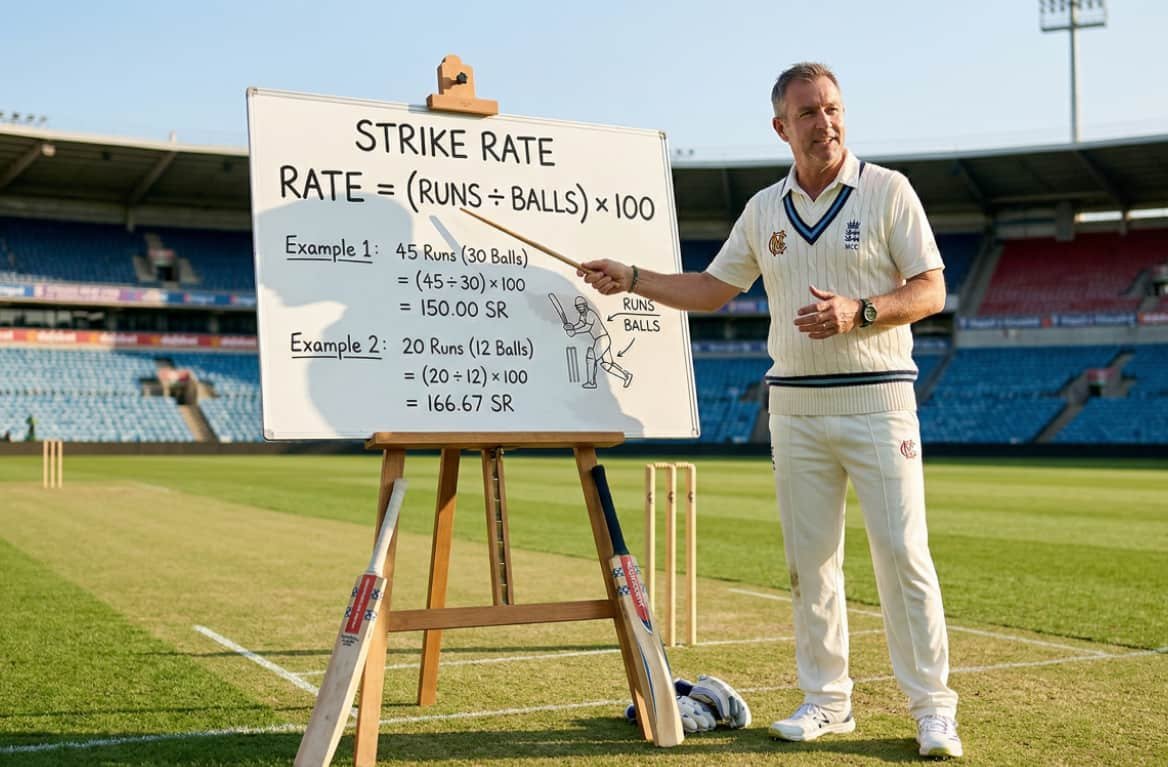
What is strike rate in batting? It runs per 100 balls, calculated with a simple formula.
The Formula
- Batting Strike Rate = (Total Runs Scored ÷ Balls Faced) × 100
Step-by-Step Calculation
Let’s calculate for a batter who scored 92 runs off 58 balls:
- Divide runs by balls: 92 ÷ 58 = 1.586
- Multiply by 100: 1.586 × 100 = 158.6
- Result: Strike rate of 158.6
This batter scores roughly 159 runs per 100 balls. That’s explosive hitting.
Quick Reference Points
- Strike rate 40-50: Very defensive, typical old-school Test batting
- Strike rate 80-90: Solid ODI batting, accumulating steadily
- Strike rate 130-140: Standard aggressive T20 batting
- Strike rate 180+: Elite power hitting, changing games single-handedly
How to Calculate Bowling Strike Rate?
Bowling strike rate inverts the logic. Lower is better.
The Formula
Bowling Strike Rate = Total Balls Bowled ÷ Wickets Taken
Step-by-Step Calculation
For a bowler who delivered 108 balls and took 5 wickets:
- Divide balls by wickets: 108 ÷ 5 = 21.6
- Result: Strike rate of 21.6
This bowler takes a wicket every 21.6 balls, or roughly every 3.6 overs. That’s excellent in any format.
Quick Reference Points
- Strike rate under 40: Elite Test bowling
- Strike rate 25-30: Excellent ODI bowling
- Strike rate 15-18: Outstanding T20 bowling
- Strike rate above 60: Struggling to take wickets consistently
Strike Rate Across Cricket Formats
Format determines what counts as good. What is the strike rate in cricket T20 versus Test cricket? Completely different standards.
Test Match Strike Rates
Test cricket rewards patience and building innings over days.
Batting expectations:
- Opening batters: 40-50 strike rate
- Middle order: 50-65 strike rate
- Aggressive players: 65-80 strike rate
Bowling expectations:
- Fast bowlers: 45-55 balls per wicket
- Spinners: 55-70 balls per wicket
- Elite pacers: Under 45 balls per wicket
ODI Strike Rates
One-day cricket balances attacking with smart cricket.
Batting expectations:
- Top order: 80-95 strike rate
- Middle order: 90-110 strike rate
- Finishers: 110-130+ strike rate
Bowling expectations:
- Opening bowlers: 30-38 balls per wicket
- Death bowlers: 35-45 balls per wicket
- Elite bowlers: Under 30 balls per wicket
T20 and IPL Strike Rates
What is the strike rate in cricket IPL? Fast, furious, and constantly rising.
Batting expectations:
- Anchors: 120-135 strike rate
- Aggressive batters: 140-155 strike rate
- Power hitters: 160-180+ strike rate
Bowling expectations:
- Powerplay bowlers: 15-20 balls per wicket
- Middle overs: 18-24 balls per wicket
- Death bowlers: Strike rate less relevant than economy
What Makes a Good Strike Rate?
“Good” changes based on multiple factors: format, match situation, pitch conditions, and player role.
Batting Strike Rate Benchmarks
| Format | Minimum | Good | Outstanding |
|---|---|---|---|
| Test | 40-50 | 55-70 | 75+ |
| ODI | 70-80 | 85-105 | 115+ |
| T20 | 100-120 | 130-150 | 165+ |
Bowling Strike Rate Benchmarks
| Format | Average | Good | Outstanding |
|---|---|---|---|
| Test | 60-75 | 48-60 | Under 48 |
| ODI | 40-50 | 28-40 | Under 28 |
| T20 | 22-28 | 16-22 | Under 16 |
Match situations override benchmarks. Chasing 200 in 18 overs? You need strike rates above 180. Batting first in Tests on a difficult pitch? A strike rate of 35 might be smart cricket.
Elite Strike Rates in International Cricket
Highest strike rate in T20 international cricket belongs to fearless power hitters who redefined what’s possible.
Top T20I Batting Strike Rates (500+ runs)
- Andre Russell (West Indies): Career strike rate around 165-170. He’s turned impossible chases into routine wins.
- Glenn Maxwell (Australia): Maintains rates near 153-158. His reverse shots and innovative batting changed how cricket is played.
- Tim David: Emerging finisher with strike rates exceeding 160, specializing in death-over explosions.
- Sunil Narine: Opening batter with rates above 165, attacking from ball one.
Notable Test Bowling Strike Rates
Players with exceptional wicket-taking speed in Tests:
- Dale Steyn (South Africa): Career strike rate of 42.3
- Kagiso Rabada (South Africa): Currently around 40-42
- Shane Bond (New Zealand): 38.8 (injury-shortened career)
- Jasprit Bumrah (India): Operating around 46-48
These bowlers take wickets nearly every 7-8 overs consistently across their careers.
Using Strike Rate Calculators
Don’t want to calculate manually? Modern tools do it instantly.
Online Calculator Options
- ESPNcricinfo: Every scorecard shows live strike rates automatically. Click any player name for career statistics.
- Cricbuzz: Real-time strike rate tracking during live matches. Historical data available for all players.
- IPL Official App: Complete IPL statistics, including season-by-season strike rates for all players.
- Google Search: Type “cricket strike rate calculator” for instant calculation tools.
Manual Calculation Benefits
Understanding the strike rate formula helps you grasp what numbers mean.
When commentators say “he needs to increase his strike rate,” you’ll know exactly how many runs per ball that requires.
Quick mental math: Scoring at 10 runs per over equals a strike rate of 166.67 (10 runs per 6 balls = 166.67 runs per 100 balls).
Why Strike Rate Matters More Than Ever?
Cricket has evolved dramatically since 2000. T20 leagues exploded globally. The IPL became a billion-dollar industry.
Franchise cricket rivals international cricket for prestige and money.
This transformation made strike rate the defining metric. IPL teams spend millions on batters maintaining 145+ strike rates.
A player averaging 32 with a 155 strike rate often earns more than someone averaging 42 with a 120 strike rate.
Even Test cricket has changed. England’s “Bazball” approach pushes strike rates above 70-80.
Teams chase wins rather than draw matches. Aggressive batting produces results faster.
For bowlers, clusters of wickets swing momentum dramatically. A bowler with a 42 strike rate can dismantle lineups before they settle, especially in helpful conditions.
Strike rate transformed from a secondary stat into the primary factor in player evaluation, auction pricing, and tactical decisions.
Frequently Asked Questions
- What is the formula for strike rate in cricket?
Batting: (Runs Scored ÷ Balls Faced) × 100. Bowling: Balls Bowled ÷ Wickets Taken. The strike rate formula differs for batting (where higher is better) and bowling (where lower is better).
- Is 140 a good strike rate in T20 cricket?
Yes, 140 is solid in T20s. It’s above the minimum needed for most teams. Top players aim for 150-165, while power hitters exceed 170. But 140 contributes positively to most T20 totals.
- How is strike rate different from average?
Strike rate measures speed. Average measures consistency. Batting average = total runs ÷ dismissals. A player can have a high strike rate but low average by scoring fast then getting out often.
- Who has the highest strike rate in IPL?
Among batters with substantial innings (500+ runs), Andre Russell leads with career IPL strike rates around 175-180. Sunil Narine and Tim David also maintain rates above 165-170.
- What is a good bowling strike rate in T20?
A good T20 bowling strike rate is 18-22 balls per wicket. Under 16 is outstanding. However, economy rate (runs per over) matters more in T20s since bowlers face limited deliveries.
- Can strike rate be over 200?
Yes, batters occasionally post strike rates above 200 in individual innings, meaning they score two or more runs per ball. This happens in explosive T20 cameos or aggressive Test declarations. Career strike rates above 200 are impossible to maintain.
Conclusion:
What is the strike rate in cricket? For batters: runs per 100 balls (higher equals better).
For bowlers: balls per wicket (lower equals better). Simple formulas, opposite interpretations.
The calculation is straightforward. The context matters enormously.
A strike rate impressive in Test cricket might be ordinary in T20s.
Format, match situation, and player role all affect what counts as good.
Understanding strike rate unlocks deeper cricket appreciation.
You’ll recognize when batters are behind required rates in chases.
You’ll appreciate bowlers who consistently take wickets every 7-8 overs in Tests.
Next time you watch cricket, track the strike rates.
They reveal who’s dominating and who’s struggling in the constant battle between bat and ball.