The Daytona 500 is NASCAR’s most iconic race – the one every driver wants on their résumé above all else.
Since the first edition in 1959, it has produced legends, upsets, and moments that refuse to fade from memory.
Whether you want to settle a debate about who has the most wins, check who took the trophy in a specific year, or just explore how the race has evolved across six decades, this complete Daytona 500 winners list has everything you need.
Daytona 500 Winners List
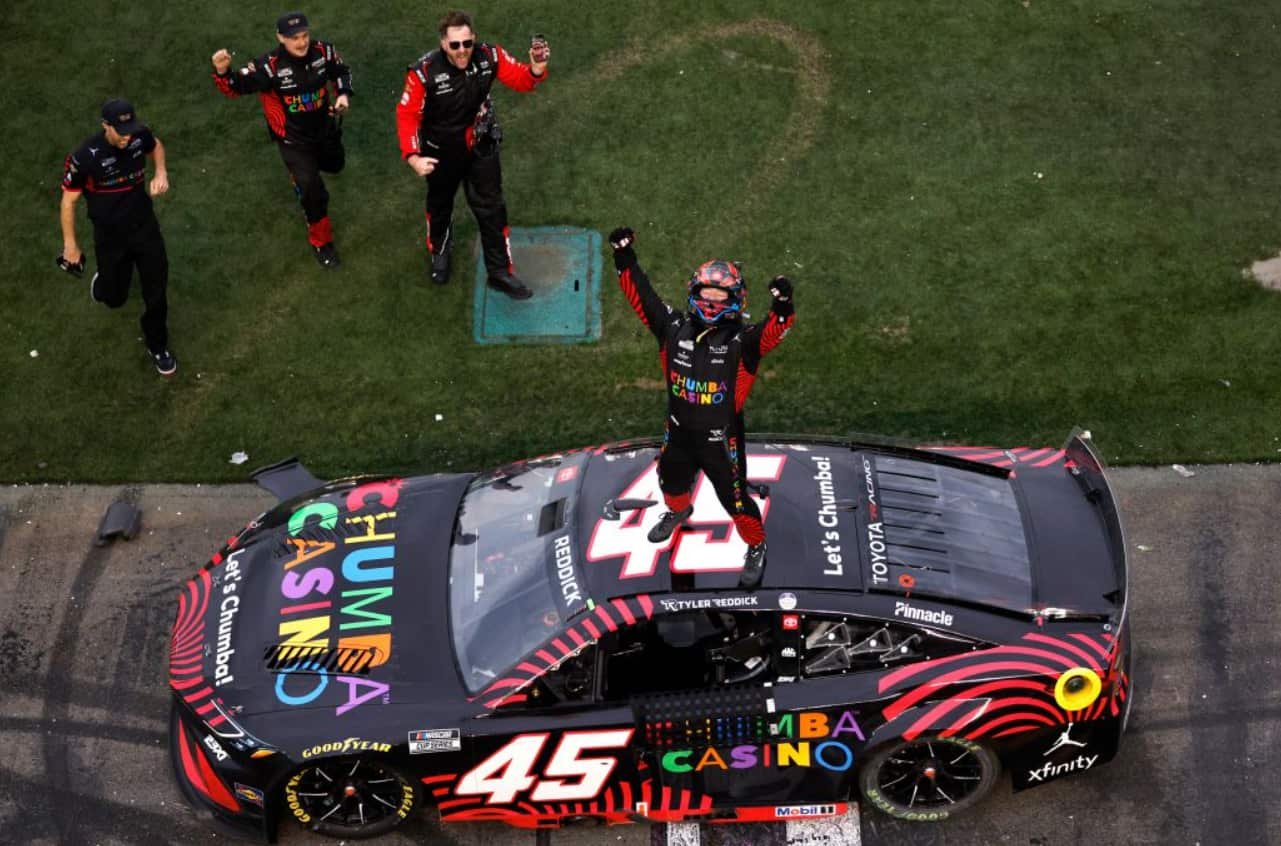
From Richard Petty’s unmatched seven victories to Tyler Reddick’s 2026 triumph, it’s all here.
Complete Daytona 500 Winners List by Year (1959–2026)
| Year | Winner | Car # | Team | Manufacturer | Avg Speed | Prize Money | Start | Margin |
|---|---|---|---|---|---|---|---|---|
| 2026 | Tyler Reddick | 45 | 23XI Racing | Toyota | 147.107 mph | $31,045,575 | 26 | 0.308 sec |
| 2025 | William Byron | 24 | Hendrick Motorsports | Chevrolet | 180.500 mph | $2,000,000 | 1 | 0.102 sec |
| 2024 | William Byron | 24 | Hendrick Motorsports | Chevrolet | 179.800 mph | $1,950,000 | 2 | 0.151 sec |
| 2023 | Ricky Stenhouse Jr. | 47 | JTG Daugherty Racing | Chevrolet | 145.283 mph | $1,923,000 | 31 | Overtime |
| 2022 | Austin Cindric | 2 | Team Penske | Ford | 142.295 mph | $1,592,000 | 20 | 0.036 sec |
| 2021 | Michael McDowell | 34 | Front Row Motorsports | Ford | 130.284 mph | $1,514,000 | 17 | 0.07 sec |
| 2020 | Denny Hamlin | 11 | Joe Gibbs Racing | Toyota | 141.110 mph | $2,100,000 | 21 | 0.014 sec |
| 2019 | Denny Hamlin | 11 | Joe Gibbs Racing | Toyota | 137.440 mph | $1,980,000 | 10 | 0.138 sec |
| 2018 | Austin Dillon | 3 | Richard Childress Racing | Chevrolet | 150.545 mph | $1,525,000 | 14 | 0.260 sec |
| 2017 | Kurt Busch | 41 | Stewart-Haas Racing | Ford | 143.187 mph | $1,510,000 | 8 | 0.228 sec |
| 2016 | Denny Hamlin | 11 | Joe Gibbs Racing | Toyota | 157.549 mph | $1,507,592 | 11 | 0.010 sec |
| 2015 | Joey Logano | 22 | Team Penske | Ford | 161.939 mph | $1,586,503 | 5 | 0.175 sec |
| 2014 | Dale Earnhardt Jr. | 88 | Hendrick Motorsports | Chevrolet | 145.290 mph | $1,506,363 | 9 | 0.092 sec |
| 2013 | Jimmie Johnson | 48 | Hendrick Motorsports | Chevrolet | 159.250 mph | $1,525,275 | 9 | 0.129 sec |
| 2012 | Matt Kenseth | 17 | Roush Fenway Racing | Ford | 140.256 mph | $1,589,387 | 4 | 0.243 sec |
| 2011 | Trevor Bayne | 21 | Wood Brothers Racing | Ford | 130.326 mph | $1,462,563 | 32 | 0.118 sec |
| 2010 | Jamie McMurray | 1 | Earnhardt Ganassi Racing | Chevrolet | 137.284 mph | $1,506,526 | 13 | 0.119 sec |
| 2009 | Matt Kenseth | 17 | Roush Fenway Racing | Ford | 132.816 mph | $1,530,388 | 43 | Rain shortened |
| 2008 | Ryan Newman | 12 | Penske Racing | Dodge | 152.672 mph | $1,506,045 | 7 | 0.092 sec |
| 2007 | Kevin Harvick | 29 | Richard Childress Racing | Chevrolet | 149.333 mph | $1,510,309 | 34 | 0.020 sec |
| 2006 | Jimmie Johnson | 48 | Hendrick Motorsports | Chevrolet | 142.667 mph | $1,505,124 | 9 | 0.134 sec |
| 2005 | Jeff Gordon | 24 | Hendrick Motorsports | Chevrolet | 135.173 mph | $1,497,815 | 15 | 0.210 sec |
| 2004 | Dale Earnhardt Jr. | 8 | Dale Earnhardt, Inc. | Chevrolet | 156.341 mph | $1,499,623 | 3 | 0.273 sec |
| 2003 | Michael Waltrip | 15 | Dale Earnhardt, Inc. | Chevrolet | 133.870 mph | $1,386,397 | 5 | Rain shortened |
| 2002 | Ward Burton | 22 | Bill Davis Racing | Dodge | 142.971 mph | $1,386,712 | 19 | 0.583 sec |
| 2001 | Michael Waltrip | 15 | Dale Earnhardt, Inc. | Chevrolet | 161.783 mph | $1,399,183 | 7 | Under caution |
| 2000 | Dale Jarrett | 88 | Robert Yates Racing | Ford | 155.669 mph | $1,277,975 | 5 | 0.229 sec |
| 1999 | Jeff Gordon | 24 | Hendrick Motorsports | Chevrolet | 161.551 mph | $2,172,246 | 4 | 0.128 sec |
| 1998 | Dale Earnhardt | 3 | Richard Childress Racing | Chevrolet | 172.712 mph | $1,059,805 | 4 | 0.119 sec |
| 1997 | Jeff Gordon | 24 | Hendrick Motorsports | Chevrolet | 148.295 mph | $1,191,884 | 9 | 0.128 sec |
| 1996 | Dale Jarrett | 88 | Robert Yates Racing | Ford | 154.308 mph | $1,061,975 | 6 | 0.12 sec |
| 1995 | Sterling Marlin | 4 | Morgan-McClure Motorsports | Chevrolet | 141.710 mph | $839,385 | 3 | 0.61 sec |
| 1994 | Sterling Marlin | 4 | Morgan-McClure Motorsports | Chevrolet | 156.931 mph | $628,000 | 10 | 0.19 sec |
| 1993 | Dale Jarrett | 18 | Joe Gibbs Racing | Chevrolet | 154.972 mph | $497,075 | 9 | 0.15 sec |
| 1992 | Davey Allison | 28 | Robert Yates Racing | Ford | 160.256 mph | $405,385 | 4 | 0.20 sec |
| 1991 | Ernie Irvan | 4 | Morgan-McClure Motorsports | Chevrolet | 148.148 mph | $360,625 | 10 | 0.15 sec |
| 1990 | Derrike Cope | 10 | Bobby Whitcomb | Chevrolet | 165.761 mph | $362,100 | 12 | 0.15 sec |
| 1989 | Darrell Waltrip | 17 | Hendrick Motorsports | Chevrolet | 148.466 mph | $357,000 | 17 | 0.20 sec |
| 1988 | Bobby Allison | 12 | Stavola Brothers Racing | Buick | 137.531 mph | $310,000 | 2 | 0.10 sec |
| 1987 | Bill Elliott | 9 | Melling Racing | Ford | 176.263 mph | $300,000 | 1 | 0.10 sec |
| 1986 | Geoff Bodine | 5 | Hendrick Motorsports | Chevrolet | 148.124 mph | $293,450 | 17 | 0.20 sec |
| 1985 | Bill Elliott | 9 | Melling Racing | Ford | 172.265 mph | $299,124 | 1 | 0.35 sec |
| 1984 | Cale Yarborough | 28 | Harry Ranier | Chevrolet | 170.894 mph | $185,500 | 1 | 0.20 sec |
| 1983 | Cale Yarborough | 28 | Harry Ranier | Pontiac | 162.032 mph | $145,000 | 3 | 0.10 sec |
| 1982 | Bobby Allison | 88 | DiGard Motorsports | Buick | 153.991 mph | $122,300 | 2 | 0.30 sec |
| 1981 | Richard Petty | 43 | Petty Enterprises | Buick | 169.651 mph | $90,575 | 5 | 0.20 sec |
| 1980 | Buddy Baker | 28 | Harry Ranier | Oldsmobile | 177.602 mph | $102,775 | 2 | 0.30 sec |
| 1979 | Richard Petty | 43 | Petty Enterprises | Oldsmobile | 143.977 mph | $73,900 | 10 | 0.20 sec |
| 1978 | Bobby Allison | 15 | Bud Moore Engineering | Ford | 159.730 mph | $73,900 | 1 | 0.10 sec |
| 1977 | Cale Yarborough | 11 | Junior Johnson & Associates | Chevrolet | 153.218 mph | $78,100 | 3 | 0.10 sec |
| 1976 | David Pearson | 21 | Wood Brothers Racing | Mercury | 152.181 mph | $67,525 | 3 | Photo finish |
| 1975 | Benny Parsons | 72 | L.G. DeWitt | Chevrolet | 153.649 mph | $56,575 | 16 | 0.40 sec |
| 1974 | Richard Petty | 43 | Petty Enterprises | Dodge | 140.894 mph | $35,300 | 7 | 3 laps |
| 1973 | Richard Petty | 43 | Petty Enterprises | Dodge | 157.205 mph | $31,160 | 2 | 0.80 sec |
| 1972 | A.J. Foyt | 21 | Wood Brothers Racing | Mercury | 161.550 mph | $31,715 | 7 | 1 lap |
| 1971 | Richard Petty | 43 | Petty Enterprises | Plymouth | 144.462 mph | $45,450 | 4 | 1 lap |
| 1970 | Pete Hamilton | 40 | Petty Enterprises | Plymouth | 149.601 mph | $32,400 | 2 | 0.50 sec |
| 1969 | LeeRoy Yarbrough | 98 | Junior Johnson | Ford | 157.950 mph | $27,450 | 19 | 0.20 sec |
| 1968 | Cale Yarborough | 21 | Wood Brothers Racing | Mercury | 147.251 mph | $25,350 | 2 | 1 lap |
| 1967 | Mario Andretti | 11 | Holman-Moody | Ford | 146.926 mph | $22,050 | 12 | 1 lap |
| 1966 | Richard Petty | 43 | Petty Enterprises | Plymouth | 160.627 mph | $21,375 | 3 | 1 lap |
| 1965 | Fred Lorenzen | 28 | Holman-Moody | Ford | 141.539 mph | $38,650 | 3 | 1 lap |
| 1964 | Richard Petty | 43 | Petty Enterprises | Plymouth | 154.334 mph | $33,300 | 2 | 1 lap |
| 1963 | Tiny Lund | 21 | Wood Brothers Racing | Ford | 151.566 mph | $24,550 | 12 | 1 sec |
| 1962 | Fireball Roberts | 22 | Smokey Yunick | Pontiac | 152.529 mph | $24,860 | 1 | 1 lap |
| 1961 | Marvin Panch | 20 | Smokey Yunick | Pontiac | 149.601 mph | $20,550 | 12 | 2 laps |
| 1960 | Junior Johnson | 27 | John Masoni | Chevrolet | 124.740 mph | $19,600 | 9 | 23 sec |
| 1959 | Lee Petty | 42 | Petty Enterprises | Oldsmobile | 135.521 mph | $19,050 | 6 | 2 feet |
Daytona 500 Winners Last 10 Years (2016–2025)
The past decade has been one of the most competitive stretches in race history. Parity is higher, fields are deeper, and upsets happen regularly.
| Year | Winner | Manufacturer |
|---|---|---|
| 2025 | William Byron | Chevrolet |
| 2024 | William Byron | Chevrolet |
| 2023 | Ricky Stenhouse Jr. | Chevrolet |
| 2022 | Austin Cindric | Ford |
| 2021 | Michael McDowell | Ford |
| 2020 | Denny Hamlin | Toyota |
| 2019 | Denny Hamlin | Toyota |
| 2018 | Austin Dillon | Chevrolet |
| 2017 | Kurt Busch | Ford |
| 2016 | Denny Hamlin | Toyota |
Chevrolet leads this decade with five wins, Ford follows with three, and Toyota rounds it out with three of its own — all belonging to Denny Hamlin.
His 2016 victory remains the closest finish in Daytona 500 history, decided by just 0.010 of a second.
The last ten years also feature a mix of first-time winners (Michael McDowell, Austin Cindric) and veterans (Denny Hamlin, Kurt Busch), making it one of the most unpredictable eras the race has seen.
Daytona 500 Winners List Since 2000
For those focused on the modern era, here’s a quick summary. Since 2000, 18 different drivers have won the Daytona 500, and Chevrolet leads manufacturer wins with 11.
Ford follows with 8, and Toyota has added 5 victories — all since 2016. No single driver has dominated this era outright, though Denny Hamlin (3 wins) and William Byron (2) stand above the rest in recent years.
Daytona 500 Winners by Manufacturer
Chevrolet — 26 Wins
No manufacturer has matched Chevrolet’s dominance at Daytona. With 26 victories spanning from 1960 to 2025, the bowtie brand holds a commanding lead in the all-time standings. Hendrick Motorsports, Richard Childress Racing, and Dale Earnhardt Inc. have been the biggest contributors. Names like Dale Earnhardt Sr., Jeff Gordon, Jimmie Johnson, and William Byron all won in Chevrolets.
Ford — 18 Wins
Ford has 18 Daytona 500 victories and has remained consistently competitive across different eras. Dale Jarrett and Ward Burton carried the flag in the late 1990s and early 2000s, while Team Penske has been Ford’s banner program in recent years, producing wins for Joey Logano, Austin Cindric, and others.
Plymouth — 7 Wins
Plymouth’s success at Daytona is almost entirely tied to Richard Petty. All seven of Plymouth’s victories came through Petty Enterprises, cementing a legacy that still stands as unmatched in the race’s history.
Dodge — 6 Wins
Dodge produced six Daytona 500 champions, with its peak years running from the late 1960s through the mid-1970s and again in the early 2000s with Ward Burton and Ryan Newman.
Toyota — 5 Wins
Toyota is the newest name on the Daytona 500 winners list and has been remarkably effective in a short time. All five of its wins have come since 2016, and every single one was driven by Denny Hamlin under the Joe Gibbs Racing banner. Three wins in under a decade are a strong foundation.
Historical Manufacturers
Pontiac, Oldsmobile, Buick, and Mercury each contributed to the early decades of the race. Buddy Baker’s 1980 Oldsmobile still holds the speed record. While none of these brands compete in NASCAR today, they are permanently woven into the race’s history.
Most Daytona 500 Wins by Driver
These are the drivers with multiple Daytona 500 victories:
| Driver | Wins | Years |
|---|---|---|
| Richard Petty | 7 | 1964, 1966, 1971, 1973, 1974, 1979, 1981 |
| Cale Yarborough | 4 | 1968, 1977, 1983, 1984 |
| Jeff Gordon | 3 | 1997, 1999, 2005 |
| Bobby Allison | 3 | 1978, 1982, 1988 |
| Denny Hamlin | 3 | 2016, 2019, 2020 |
| Dale Jarrett | 3 | 1993, 1996, 2000 |
| Sterling Marlin | 2 | 1994, 1995 |
| Bill Elliott | 2 | 1985, 1987 |
| Michael Waltrip | 2 | 2001, 2003 |
| Dale Earnhardt Jr. | 2 | 2004, 2014 |
| Jimmie Johnson | 2 | 2006, 2013 |
| Matt Kenseth | 2 | 2009, 2012 |
| William Byron | 2 | 2024, 2025 |
Richard Petty’s seven wins represent a 10.4% win rate across 67 editions of the race — a number that may never be approached.
Back-to-Back Daytona 500 Winners
Winning the Daytona 500 once is hard enough. Doing it in back-to-back years puts a driver in truly elite company.
Only five drivers in history have managed consecutive wins:
| Driver | Years |
|---|---|
| William Byron | 2024 & 2025 |
| Denny Hamlin | 2019 & 2020 |
| Sterling Marlin | 1994 & 1995 |
| Cale Yarborough | 1983 & 1984 |
| Richard Petty | 1973 & 1974 |
William Byron is the most recent to achieve the feat, and the first since Hamlin to do it in the 2020s.
The challenge isn’t just talent — Daytona’s pack racing format, caution laps, and unpredictable late-race chaos make repeat success genuinely difficult. That’s what makes each name on this list special.
Youngest and Oldest Daytona 500 Winners
Youngest: Trevor Bayne — 20 years, 1 day (2011)
Bayne pulled off one of the biggest upsets in NASCAR history when he won the 2011 Daytona 500 for Wood Brothers Racing in just his second Cup Series start. He was 20 years and one day old. It remains one of the race’s most stunning moments.
Oldest: Bobby Allison — 50 years, 73 days (1988)
Bobby Allison was 50 years old when he won his final Daytona 500 in 1988, driving for Stavola Brothers Racing. That win, at an age when most drivers have long retired, stands as a testament to just how much racecraft matters at Daytona.
The trend in recent years leans younger. Austin Cindric, William Byron, and Ricky Stenhouse Jr. all won in their 20s or early 30s, suggesting the sport’s youth movement is producing Daytona champions earlier than ever.
How Much Do Daytona 500 Winners Earn? (Prize Money)
The financial reward for winning the Daytona 500 has grown dramatically over the decades.
| Era | Approximate Winner’s Prize |
|---|---|
| 1959 | ~$19,000 |
| 1981 | ~$90,575 |
| 1998 | ~$1,059,805 |
| 2020 | ~$2,100,000 |
| 2025 | ~$2,000,000+ |
The total race purse in 2025 exceeded $28 million, distributed across all competitors.
Beyond the base prize, winning drivers typically receive team performance bonuses, manufacturer incentives, and increased sponsorship value — making the real financial impact of a Daytona win far larger than the posted figure alone.
For context, Richard Petty’s 1979 win paid $73,900. Adjusted for inflation, that’s roughly $300,000 in today’s money — significant, but a fraction of what modern winners take home.
Starting Position vs. Winning — Does Pole Matter?
Daytona’s drafting-heavy, pack-racing format makes it one of the few events in motorsport where starting position has a surprisingly weak correlation with the final result.
Only about 10 Daytona 500 winners have started from the pole — roughly 14.9% of all races. The average winning starting position across all editions sits around 14th place.
Matt Kenseth’s 2009 win from the 43rd starting spot (a rain-shortened race) is the most extreme example of how little the front row guarantees.
That said, the starting position isn’t irrelevant. Running up front in the early stages can help avoid early-race incidents.
But in the final ten laps, what matters most is who has fuel, fresh tires, and a strong drafting partner — not where they lined up at the green flag.
Fastest Daytona 500 Performances — Speed Records
The fastest Daytona 500 in history was run in 1980, when Buddy Baker averaged 177.602 mph across all 500 miles.
The race ran completely caution-free — an extraordinary rarity at Daytona — giving Baker an uninterrupted run at full speed.
Bill Elliott’s 1987 win is also worth noting: he averaged 176.263 mph, the second-fastest ever, again in near-perfect conditions.
By contrast, rain-interrupted or accident-heavy races have seen winning averages fall below 130 mph.
The slowest conditions on record include the 2021 race won by Michael McDowell at 130.284 mph, shaped by multiple extended caution periods.
NASCAR’s introduction of restrictor plates and later tapered spacers has capped top-end speeds for safety, meaning Buddy Baker’s 1980 record is unlikely to be broken under current rules.
Daytona 500 Winner 2026
Tyler Reddick won the 2026 Daytona 500, driving the No. 45 Toyota for 23XI Racing.
He started from 26th position and won by a margin of 0.308 seconds, averaging 147.107 mph.
His prize totaled $31,045,575 — the largest single-race payout in NASCAR history.
Frequently Asked Questions
- Who has won the Daytona 500 the most times?
Richard Petty holds the record with 7 Daytona 500 wins between 1964 and 1981, all driving for Petty Enterprises. No other driver has come within four wins of that total.
- Who won the Daytona 500 in 2026?
Tyler Reddick won the 2026 Daytona 500, driving the No. 45 Toyota for 23XI Racing. He started 26th and won by 0.308 seconds, earning over $31 million in prize money.
- Who won the Daytona 500 in 2025?
William Byron won in 2025, successfully defending his 2024 title. He drove the No. 24 Chevrolet for Hendrick Motorsports and started from pole position, winning by 0.102 seconds.
- What manufacturer has the most Daytona 500 wins?
Chevrolet leads all manufacturers with 26 victories. Ford is second with 18, followed by Plymouth with 7, Dodge with 6, and Toyota with 5.
- Who is the youngest Daytona 500 winner?
Trevor Bayne won the 2011 Daytona 500 at 20 years and 1 day old — the youngest winner in the race’s history. He was driving in just his second Cup Series start.
- Who is the oldest Daytona 500 winner?
Bobby Allison is the oldest, winning the 1988 edition at 50 years and 73 days old.
- Has anyone won back-to-back Daytona 500s?
Yes — five drivers have won consecutive editions: William Byron (2024–2025), Denny Hamlin (2019–2020), Sterling Marlin (1994–1995), Cale Yarborough (1983–1984), and Richard Petty (1973–1974).
- What is the fastest Daytona 500 ever run?
Buddy Baker averaged 177.602 mph in the 1980 Daytona 500 — the fastest ever recorded. The race ran without a single caution lap.
Conclusion:
The Daytona 500 winners list reads like a who’s who of NASCAR greatness — from Lee Petty’s photo-finish win in 1959 to Tyler Reddick’s 2026 triumph.
Richard Petty’s seven wins stand alone at the top, Chevrolet leads all manufacturers with 26 victories, and the back-to-back champions form a short but elite club.
What makes this race special isn’t just the names on the list.
It’s the upsets (Trevor Bayne at 20), the dynasties (Denny Hamlin’s three wins), and the moments of pure chaos that remind everyone why Daytona remains the crown jewel of NASCAR’s season.
Bookmark this page. As new champions are crowned each February, this list will keep growing.